Variational Inference for Graph Convolutional Networks in the Absence of Graph Data and Adversarial Settings
Jun 1, 2020· ·
1 min read
·
1 min read
Pantelis Elinas
Equal contribution
,Edwin V. Bonilla
Equal contribution
Louis Tiao
Abstract
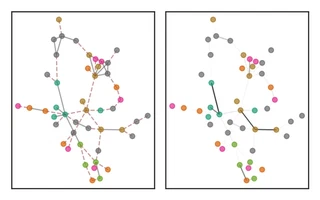
We propose a framework that lifts the capabilities of graph convolutional networks (GCNs) to scenarios where no input graph is given and increases their robustness to adversarial attacks. We formulate a joint probabilistic model that considers a prior distribution over graphs along with a GCN-based likelihood and develop a stochastic variational inference algorithm to estimate the graph posterior and the GCN parameters jointly. To address the problem of propagating gradients through latent variables drawn from discrete distributions, we use their continuous relaxations known as Concrete distributions. We show that, on real datasets, our approach can outperform state-of-the-art Bayesian and non-Bayesian graph neural network algorithms on the task of semi-supervised classification in the absence of graph data and when the network structure is subjected to adversarial perturbations.
Type
Publication
Advances in Neural Information Processing Systems 33 (NeurIPS2020)
This paper is a follow-up to our working paper, previously presented at the NeurIPS2019 Graph Representation Learning Workshop, now with significantly expanded experimental analyses.
Graph Representation Learning
Variational Inference
Semi-Supervised Learning
Probabilistic Models
Machine Learning
Authors

Authors
Research Scientist
My name is Louis Tiao, and I graduated from one of Australia’s
top engineering schools with really good grades.
Now, I’m using my knowledge to help up-and-coming tech companies
make it in this competitive world.