Empirical Gaussian Processes
Feb 1, 2026· ,,,·
0 min read
,,,·
0 min read
Jihao Andreas Lin
Co-first author
,Sebastian Ament
Co-first author
Louis Tiao
David Eriksson
Maximilian Balandat
Eytan Bakshy
Abstract
Gaussian processes (GPs) are powerful and widely used probabilistic
regression models, but their effectiveness in practice is often limited by
the choice of kernel function. This kernel function is typically
handcrafted from a small set of standard functions, a process that requires
expert knowledge, results in limited adaptivity to data, and imposes strong
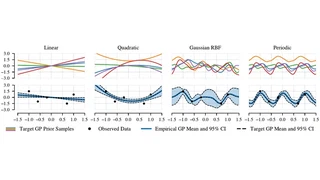
assumptions on the hypothesis space. We study Empirical GPs, a principled
framework for constructing flexible, data-driven GP priors that overcome
these limitations. Rather than relying on standard parametric kernels, we
estimate the mean and covariance functions empirically from a corpus of
historical observations, enabling the prior to reflect rich, non-trivial
covariance structures present in the data. Theoretically, we show that the
resulting model converges to the GP that is closest (in KL-divergence
sense) to the real data generating process. Practically, we formulate the
problem of learning the GP prior from independent datasets as likelihood
estimation and derive an Expectation-Maximization algorithm with
closed-form updates, allowing the model to handle heterogeneous observation
locations across datasets. We demonstrate that Empirical GPs achieve
competitive performance on learning curve extrapolation and time series
forecasting benchmarks.
Type
Publication
Proceedings of the 43rd International Conference on Machine Learning (ICML 2026)
