Your second-worst review is probably all you need
We analyze nine years of ICLR reviews and find that Reviewer 2 is not the problem.

We analyze nine years of ICLR reviews and find that Reviewer 2 is not the problem.
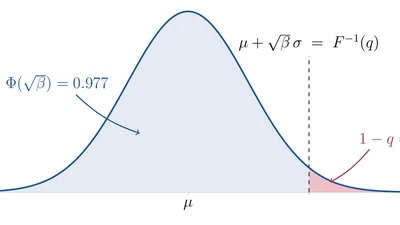
We show that UCB is a quantile of the predictive distribution in disguise, elicitable by the pinball loss even though no scalar loss can elicit the moment formula directly. The …
We tour a chezmoi-templated dotfiles setup that bootstraps a fresh machine in one command — terminal, shell, prompt, multiplexer, multi-environment templating, and the developer …
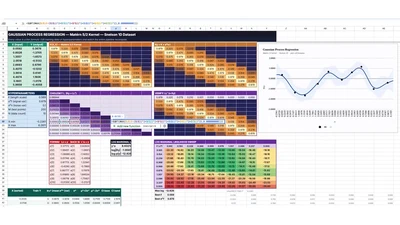
We implement a fully functional Gaussian Process regression pipeline — Cholesky decomposition, posterior predictions, and gradient-based hyperparameter optimization — in pure …

We give a short and practical guide to efficiently computing the Cholesky decomposition of matrices perturbed by low-rank updates.
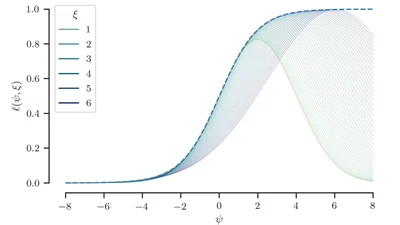
We swap Gibbs sampling for mean-field variational inference in the Pólya-Gamma augmented model and watch the classical Jaakkola-Jordan bound on the logistic sigmoid fall out, EM …
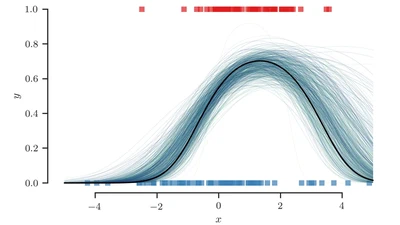
We use one weird trick — Pólya-Gamma augmentation — to make exact inference in Bayesian logistic regression tractable.
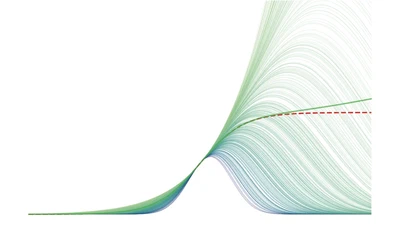
We collect the identities that make the Pólya-Gamma augmentation tick: the logistic sigmoid in terms of the hyperbolic cosine, the hyperbolic cosine as a Pólya-Gamma Laplace …
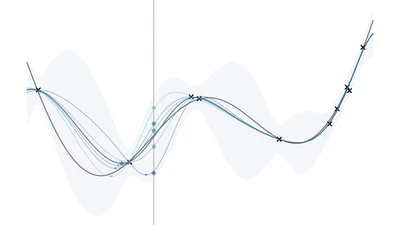
We give a short illustrated reference guide to the Knowledge Gradient acquisition function with an implementation from scratch in TensorFlow Probability.
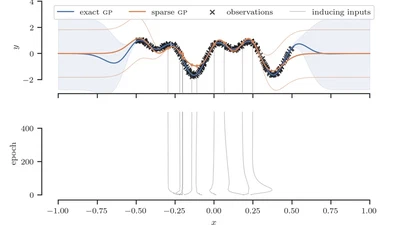
We summarize the notation, identities, and derivations underlying the sparse variational Gaussian process (SVGP) framework.